Skip to content
A FIELD GUIDE TO CURIOSITY / 01

A small world.
Worth a
closer look.

Rain has passed through a little garden. The leaves still move. Water holds on. Small lives get on with their day.

This is After the Rain: a living, interactive composition you can touch, observe, and investigate.

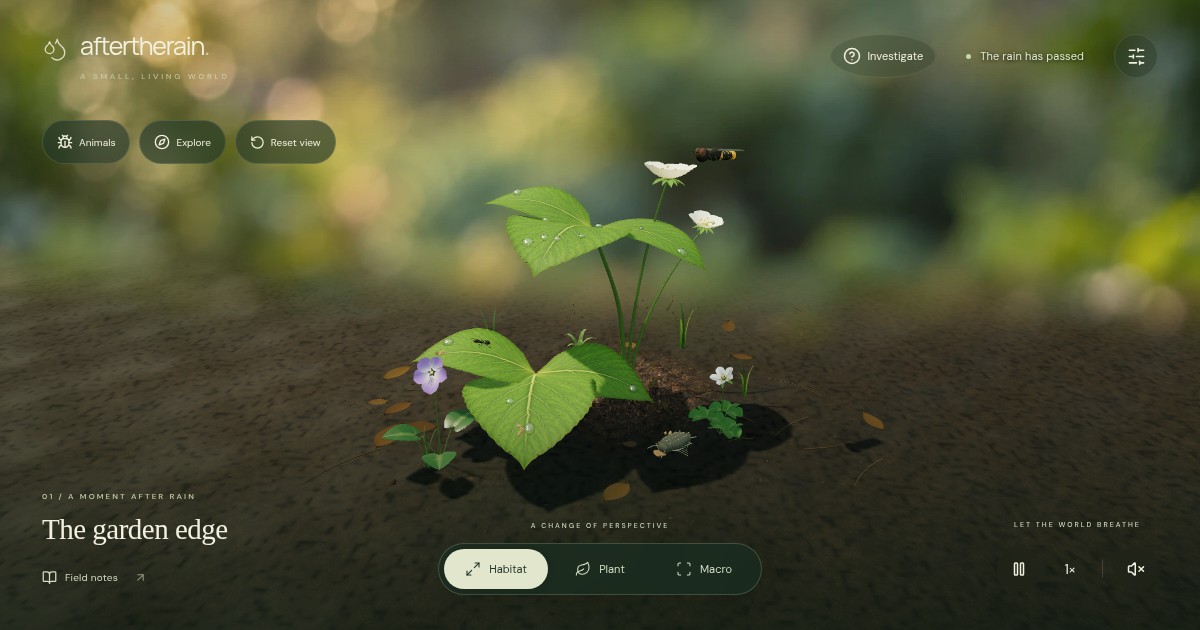
The interactive garden, with wet strawberry leaves and small flowers above damp soil
01 / THE GARDEN EDGE An actual view from the interactive garden.
THE IDEA IS SIMPLE

Give a small thing
your full attention.

A leaf is a landscape when you come close enough. A drop becomes a question. An animal’s next move becomes something worth waiting for.

After the Rain makes room for that kind of looking. You can stay with the scene, make a gentle intervention, or follow your curiosity into a controlled investigation. There is no score to chase.

NoticeTouchWatchAsk again
THREE WAYS TO FOLLOW A QUESTION

Wonder has
somewhere to go.

Change a condition. Compare what happens.
Then try a different explanation.

01
WATER ON A LEAF

What makes a drop let go?

Change volume, tilt, and hypothetical surface pinning. Watch water move, merge, or leave the leaf. Discover why a bigger drop can behave differently on the same surface.

Investigate the drop
02
THE WATER–CARBON TRADEOFF

Open for carbon. Lose water.

Change light and air humidity. A labeled microscopic diagram reveals pores that regulate carbon access and water loss. Compare the two fluxes, including diminishing returns and dark respiration.

Look inside the leaf
03
BEHAVIOR & MICROCLIMATE

Find damp air without a map?

Change one side of a virtual woodlouse chamber. Local movement and resting rules produce different paths and residence times. Six paired trials show why one path is never the whole story.

Follow the small lives
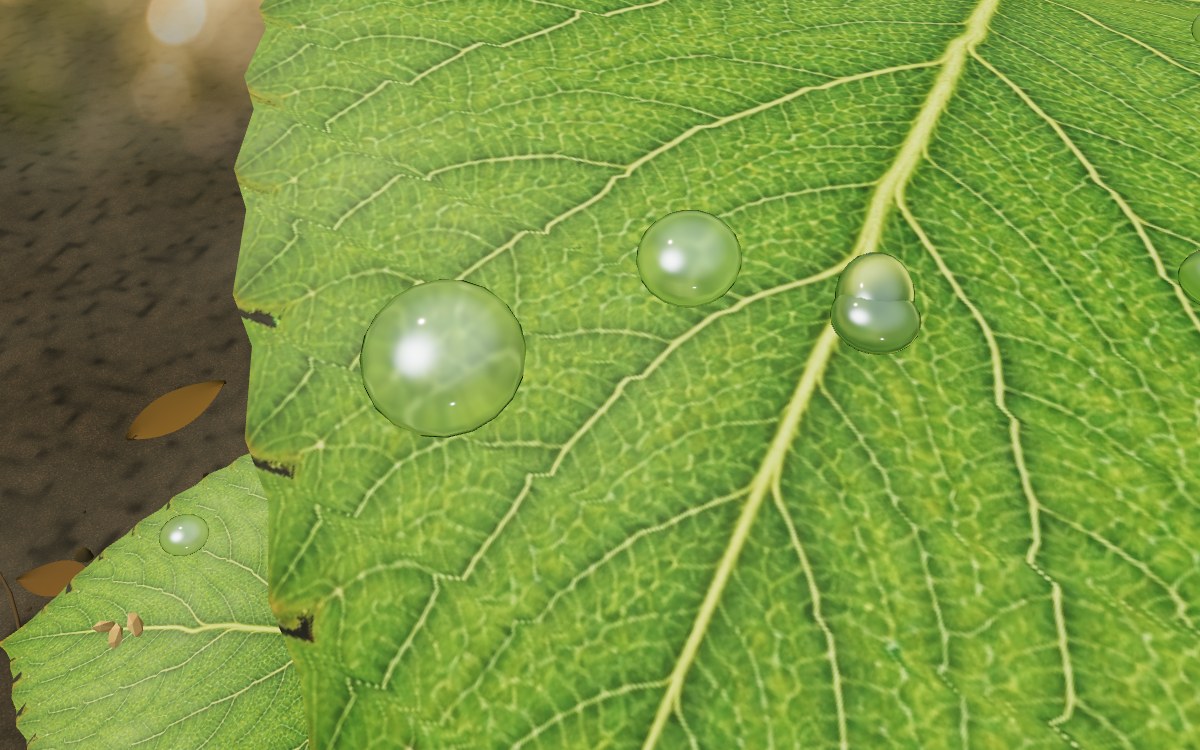
A close view of actual modeled drops resting on the textured strawberry leaf
Come close. Keep the question open.
REAL CONSEQUENCES. VISIBLE LIMITS.

A model, with
its edges showing.

These are explanatory models. They make relationships easier to explore, while leaving out much of a real plant, animal, or fluid.

The scientific investigations declare their conditions, approximations, simulated time, and sources. Their numbers are model output, not measured strawberry rates or field predictions. The microscopic view is a diagram, clearly separate from the camera.

What makes the world feel alive?

Plants bend and recover. Water moves through a conserved inventory. Ants carry finite supplies, a hoverfly visits flowers, and a woodlouse responds to its habitat. Your actions change their conditions; the scene continues while you watch.

What do I need to explore?

A current browser with JavaScript and hardware-accelerated WebGL 2. Use a mouse, touch, or the available keyboard controls. Choose sound or silence, pause or slow time, and use stepped observations in the investigations. Reduced motion is respected. Hardware performance varies by device.
NO SCORE. NO HURRY.

There is a lot
in a little.

Follow a drop. Wait for a small animal.
Find out what changes when you touch a leaf.

Take a closer look